

The convergence of 5G networks and Internet of Things (IoT) technology stands as one of the most transformative emerging technologies reshaping Canadian business operations. With speeds up to 100 times faster than 4G and ultra-low latency, 5G IoT enables real-time data processing, autonomous systems, and seamless connectivity across millions of devices simultaneously. Canadian manufacturers are already leveraging this technology to optimize production lines, while smart cities from Vancouver to Toronto are implementing 5G IoT solutions for enhanced public services and infrastructure management. For business leaders, this technological leap represents an unprecedented opportunity to automate operations, gather actionable insights, and create new revenue streams through innovative connected services. As Canada positions itself as a global leader in 5G deployment, understanding and implementing these solutions has become crucial for maintaining competitive advantage in an increasingly connected marketplace.

How 5G Supercharges IoT for Canadian Companies
Lightning-Fast Data Processing
The integration of 5G technology with IoT devices revolutionizes data processing capabilities, delivering unprecedented speed and efficiency for Canadian businesses. With latency reduced to as low as 1 millisecond – compared to 4G’s 20-30 milliseconds – organizations can now process and act on data in near real-time.
This dramatic reduction in latency enables critical applications where split-second responses matter. Manufacturing facilities can implement instant machine-to-machine communication for precise automation, while healthcare providers can conduct remote procedures with minimal delay. As noted by Dr. Sarah Chen, Director of Technology at Rogers Communications, “The enhanced bandwidth of 5G allows thousands of devices to communicate simultaneously without performance degradation.”
The increased bandwidth capacity supports data transmission rates up to 20 Gbps, enabling businesses to handle massive amounts of sensor data, high-definition video streams, and complex analytics simultaneously. Toronto-based smart city initiative “SmartTO” demonstrates these capabilities, managing over 10,000 connected sensors across the city while processing environmental data in real-time.
For businesses implementing IoT solutions, this means:
– Improved operational efficiency through instant data analysis
– Enhanced real-time monitoring and control systems
– Support for high-density device deployment
– Reduced network congestion in busy environments
– Better quality of service for data-intensive applications
This combination of reduced latency and increased bandwidth creates new possibilities for innovation across industries, from automated warehouses to connected healthcare solutions.
Massive Device Connectivity
The defining feature of 5G IoT is its extraordinary capacity to connect an unprecedented number of devices simultaneously. While 4G networks typically support about 2,000 devices per square kilometer, 5G technology enables connectivity for up to one million devices within the same area. This massive leap in device density opens new possibilities for Canadian businesses across various sectors.
Bell Canada has demonstrated this capability in their smart city initiatives, where thousands of sensors, cameras, and connected devices work together seamlessly. In industrial settings, manufacturing plants can now deploy extensive networks of sensors and automated systems without worrying about network congestion or interference.
The enhanced network capacity particularly benefits urban centers like Toronto, Vancouver, and Montreal, where device density is highest. Smart building implementations, for instance, can now incorporate thousands of connected sensors for monitoring everything from energy usage to occupancy levels, all operating simultaneously without performance degradation.
For businesses planning large-scale IoT deployments, this increased capacity eliminates the need for complex network planning and allows for future scalability. Canadian agriculture tech companies are leveraging this capability to deploy vast networks of soil sensors and automated irrigation systems across large farming operations.
The reduced latency and increased bandwidth of 5G further complement this massive connectivity, ensuring that even with thousands of connected devices, each maintains optimal performance and real-time data transmission capabilities.
Real Canadian Success Stories with 5G IoT
Manufacturing Innovation
The integration of 5G and IoT technologies is revolutionizing manufacturing across Canada, with smart factories leading the transformation. At the forefront of this evolution, companies within our thriving Canadian tech ecosystems are implementing innovative solutions that demonstrate the practical benefits of this technology convergence.
Consider Magna International’s Aurora facility, where 5G-connected sensors monitor production lines in real-time, reducing downtime by 27% and improving quality control through instantaneous data analysis. The facility’s automated guided vehicles (AGVs) navigate the factory floor using ultra-reliable low-latency communication (URLLC), enabling precise coordination and enhanced safety protocols.
Quebec-based Bombardier Aerospace has implemented a 5G-powered digital twin system that creates virtual replicas of their manufacturing processes. This innovation allows engineers to simulate and optimize production workflows before implementation, resulting in a 15% increase in operational efficiency.
In Vancouver, industrial automation specialist ATS Automation has developed a 5G-enabled predictive maintenance system that analyzes equipment performance in milliseconds. Their solution has helped manufacturers reduce maintenance costs by up to 30% while extending machine life spans.
The impact extends to smaller manufacturers as well. Ontario’s manufacturing innovation network has established a shared 5G testbed where SMEs can trial IoT solutions before full implementation. This initiative has enabled dozens of manufacturers to modernize their operations without significant upfront investment.
These real-world applications demonstrate how 5G IoT is not just a technological upgrade but a fundamental shift in manufacturing capability, offering Canadian manufacturers unprecedented levels of control, efficiency, and innovation potential.

Smart Agriculture Revolution
Canadian agriculture is experiencing a transformative shift through 5G IoT implementation, with smart farming solutions revolutionizing traditional practices across the country. In Ontario’s farming belt, precision agriculture systems powered by 5G networks are enabling farmers to monitor soil conditions, crop health, and weather patterns in real-time, leading to up to 20% increases in crop yields.
Several Canadian agtech companies have successfully deployed 5G-enabled autonomous tractors and harvesting equipment, reducing labor costs while improving efficiency. For instance, Manitoba-based Prairie Tech Solutions has implemented a network of IoT sensors across 50,000 acres, helping farmers optimize irrigation and reduce water usage by 30%.
“The integration of 5G IoT in agriculture isn’t just about technology – it’s about creating sustainable farming practices while improving productivity,” says Dr. Sarah Thompson, Agricultural Technology Specialist at the University of Guelph.
Smart greenhouses in British Columbia are utilizing 5G-connected climate control systems and automated plant monitoring, extending growing seasons and increasing production capacity. These facilities use AI-powered cameras and sensors to adjust temperature, humidity, and lighting conditions automatically.
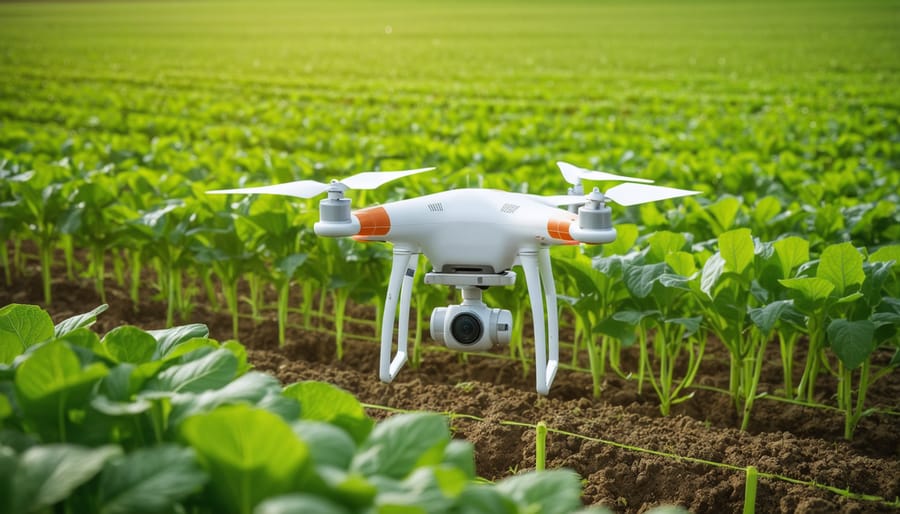
The federal Smart Agriculture Initiative has supported the deployment of 5G infrastructure in rural areas, enabling farmers to access advanced IoT solutions. This investment has resulted in the development of innovative applications such as livestock tracking systems and drone-based crop monitoring.
Canadian farmers are reporting significant ROI from these implementations, with early adopters seeing reduced operational costs of 15-25% and improved crop quality. The combination of 5G reliability and IoT capabilities is proving particularly valuable during critical harvest periods, where real-time decision-making can significantly impact yields.
Implementation Strategies for Canadian Businesses
Assessment and Planning
Before implementing 5G IoT solutions, organizations must conduct a thorough assessment of their current infrastructure, business objectives, and operational requirements. Start by identifying specific use cases that align with your company’s goals and potential return on investment opportunities.
Create a detailed inventory of existing connected devices and systems, evaluating their compatibility with 5G technology. Consider factors such as network coverage requirements, data processing needs, and security protocols. This assessment should include consultation with stakeholders across different departments to ensure comprehensive understanding of operational needs.
Develop a phased implementation roadmap that prioritizes high-impact, low-risk initiatives first. Your plan should address:
– Network infrastructure requirements
– Device upgrade or replacement schedule
– Security and compliance measures
– Staff training needs
– Budget allocation
– Timeline milestones
– Performance metrics
Industry experts recommend working with experienced telecommunications partners to conduct feasibility studies and technical assessments. Leading Canadian telecommunications providers offer assessment tools and consulting services to help businesses evaluate their 5G IoT readiness.
Remember to factor in scalability and future expansion possibilities. Your implementation plan should be flexible enough to accommodate technological advances and changing business needs. Regular review and adjustment of the plan ensures alignment with evolving market conditions and organizational objectives.
Successful implementation often requires cross-functional team collaboration and clear communication channels between technical and business units. Consider establishing a dedicated project team to oversee the transition and maintain accountability throughout the process.
Government Support and Resources
The Canadian government has demonstrated strong commitment to advancing 5G IoT technology through various support initiatives and funding programs. Innovation, Science and Economic Development Canada (ISED) offers targeted grants specifically for businesses implementing IoT solutions through their digital adoption programs.
The Strategic Innovation Fund (SIF) provides significant financial support for large-scale 5G IoT projects, with investments ranging from $10 million to $50 million for qualifying initiatives. Small and medium-sized enterprises can access the Industrial Research Assistance Program (IRAP), which offers both funding and technical expertise for IoT implementation.
Regional development agencies like Western Economic Diversification Canada and the Atlantic Canada Opportunities Agency provide location-specific support, including matching funds for IoT infrastructure development. The Scientific Research and Experimental Development (SR&ED) tax incentive program offers tax credits for companies investing in IoT research and development.
Additionally, the Universal Broadband Fund’s $1.75 billion investment includes provisions for IoT connectivity infrastructure, particularly benefiting rural and remote communities. Business owners can also access expertise through the National Research Council’s Technology Access Centres, which provide specialized guidance for IoT implementation and optimization.
These programs demonstrate Canada’s dedication to becoming a global leader in 5G IoT innovation while ensuring businesses across the country can participate in this technological transformation.
Future-Proofing Your Business with 5G IoT
As Canadian businesses navigate the evolving technological landscape, future-proofing operations with 5G IoT has become increasingly crucial. Industry experts predict that by 2025, the number of IoT devices in Canada will triple, creating unprecedented opportunities for innovation and growth.
To stay competitive, businesses should focus on developing scalable IoT infrastructure that can adapt to emerging technologies. This includes implementing flexible hardware solutions and cloud-based platforms that can easily integrate with future 5G applications. Canadian telecommunications leader Rogers Communications suggests that companies should prioritize modular systems that allow for seamless upgrades without requiring complete infrastructure overhauls.
Strategic investment in 5G IoT capabilities is particularly transformative for digital transformation in rural areas, where improved connectivity can level the playing field with urban centers. Forward-thinking businesses are already exploring advanced applications such as autonomous systems, remote operations, and predictive maintenance solutions that leverage 5G’s enhanced capabilities.
Key steps for future-proofing your business include:
1. Conducting regular technology audits to identify potential upgrade paths
2. Investing in employee training and skills development
3. Establishing partnerships with IoT solution providers and industry experts
4. Developing clear data management strategies
5. Creating flexible budgets for technology adoption
The Canadian government’s commitment to expanding 5G infrastructure nationwide provides businesses with a solid foundation for long-term planning. Companies that begin implementing 5G IoT solutions today will be better positioned to capitalize on emerging opportunities, from enhanced supply chain visibility to advanced automation systems.
Remember that future-proofing isn’t just about technology – it’s about creating an organizational culture that embraces innovation and continuous improvement. Successful businesses will be those that maintain adaptability while building upon the robust foundation that 5G IoT provides.
The convergence of 5G and IoT represents a transformative opportunity for Canadian businesses across all sectors. As we’ve explored throughout this article, the combination of ultra-fast connectivity, minimal latency, and massive device support enables unprecedented possibilities for innovation and growth.
Canadian organizations that embrace 5G IoT solutions position themselves at the forefront of digital transformation, gaining competitive advantages through enhanced operational efficiency, improved customer experiences, and new revenue streams. From smart manufacturing facilities in Ontario to connected agriculture in the Prairies, early adopters are already demonstrating the tangible benefits of this technology.
To capitalize on these opportunities, businesses should begin by assessing their current infrastructure and identifying specific use cases where 5G IoT can deliver value. Start with pilot projects, collaborate with experienced technology partners, and develop a clear implementation roadmap that aligns with your business objectives.
The Canadian government’s continued investment in 5G infrastructure and supportive policies creates a favorable environment for innovation. With major telecom providers expanding their 5G networks nationwide, the time is right for businesses to take action.
Don’t wait for competitors to lead the way. Begin your 5G IoT journey today by consulting with industry experts, attending technology forums, and connecting with successful implementers in your sector. The future of Canadian business is connected, intelligent, and powered by 5G IoT – ensure your organization is ready to thrive in this new era.