

Strategic market research drives successful business expansion by revealing hidden opportunities and critical market dynamics that shape market entry success. In today’s rapidly evolving Canadian business landscape, comprehensive market analysis serves as the foundation for informed decision-making and competitive advantage.
Effective strategic research combines rigorous data analysis with deep cultural understanding, enabling businesses to identify profitable market segments, assess competitive dynamics, and align offerings with local consumer preferences. This methodical approach has proven particularly vital for international companies entering Canada’s diverse regional markets, where consumer behaviors and regulatory requirements vary significantly across provinces.
Leading Canadian firms consistently demonstrate that strategic market research goes beyond basic demographic data and market size calculations. It demands a nuanced understanding of industry trends, regulatory frameworks, and emerging technological disruptions that could reshape market dynamics. Through systematic analysis of both quantitative metrics and qualitative insights, businesses can develop targeted strategies that resonate with Canadian consumers while maintaining operational efficiency.
This strategic approach to market research has become increasingly critical as digital transformation accelerates market changes and consumer expectations evolve. Organizations that invest in comprehensive market analysis consistently demonstrate stronger market positioning, more effective resource allocation, and higher success rates in new market ventures.
For business leaders planning market expansion, strategic research provides the clarity needed to make confident decisions and establish sustainable competitive advantages in Canada’s dynamic business environment.
The Foundation of Market Entry Success
Primary vs. Secondary Research in the Canadian Context
In the Canadian market, successful research strategies typically combine both primary and secondary research methods to create a comprehensive understanding of market dynamics. Primary research involves direct data collection through surveys, interviews, and focus groups with Canadian consumers and businesses. This approach provides fresh, market-specific insights that reflect current Canadian preferences and behaviors.
Leading Canadian market research firm Leger notes that primary research is particularly valuable when exploring regional differences across provinces and territories. For example, consumer preferences in Quebec often differ significantly from those in British Columbia, making localized primary research essential for accurate market assessment.
Secondary research, meanwhile, leverages existing data from reliable Canadian sources such as Statistics Canada, Industry Canada, and provincial economic development agencies. This method offers cost-effective access to comprehensive market data, demographic information, and industry trends specific to the Canadian context.
Many successful Canadian businesses, like Shopify and Canada Goose, have demonstrated the effectiveness of combining both approaches. They typically begin with secondary research to establish market fundamentals, followed by targeted primary research to validate assumptions and identify unique market opportunities.
For optimal results, Canadian market researchers recommend allocating 60-70% of research efforts to secondary research for initial market understanding, followed by 30-40% to primary research for validation and deeper insights into specific market segments or regions.

Data-Driven Decision Making
Transforming market research data into actionable insights requires a systematic approach that aligns with proven market entry strategies. Successful Canadian businesses consistently demonstrate that effective decision-making stems from properly analyzing and interpreting research findings.
Start by establishing clear metrics that align with your business objectives. Focus on key performance indicators (KPIs) such as market size, growth potential, competitive landscape, and consumer behavior patterns. Canadian market leaders like Shopify and Lightspeed POS attribute their success to rigorous data analysis before making strategic moves.
Create a decision matrix that weighs various factors according to their importance to your business. Consider both quantitative data (market statistics, financial projections) and qualitative insights (consumer feedback, expert opinions). Industry expert Sarah Thompson of the Toronto Business Advisory Group suggests, “Successful market entry decisions are 80% thorough analysis and 20% calculated risk-taking.”
Implement a structured review process that includes:
– Regular data validation and updates
– Cross-referencing multiple data sources
– Stakeholder feedback integration
– Market trend correlation analysis
Remember to account for regional variations across Canadian provinces and territories. Use data visualization tools to identify patterns and present findings to stakeholders effectively. This approach helps ensure that your market entry decisions are both evidence-based and strategically sound.
Key Research Areas for Canadian Market Entry
Consumer Behavior and Market Demand
Canadian consumers are known for their diverse preferences and unique buying behaviors, shaped by factors such as cultural diversity, regional differences, and economic conditions. Understanding these patterns is crucial for successful market entry and expansion strategies.
Research shows that Canadian consumers prioritize quality, value for money, and brand reputation in their purchasing decisions. They are increasingly environmentally conscious, with 78% of consumers considering sustainability when making purchases. Digital adoption continues to rise, with e-commerce sales growing by 75% since 2019, indicating a strong preference for omnichannel shopping experiences.
Regional variations play a significant role in consumer behavior. For instance, Quebec consumers often show distinct preferences compared to other provinces, particularly in areas like brand loyalty and local product support. Urban centers like Toronto, Vancouver, and Montreal demonstrate different consumption patterns than rural areas, necessitating tailored market approaches.
Market demand analysis should consider demographic shifts, such as the aging population and increasing cultural diversity. According to Statistics Canada, millennials and Gen Z now represent over 40% of the consumer base, bringing new expectations for digital integration and social responsibility.
As noted by Sarah Chen, CEO of Canadian Consumer Insights: “Success in the Canadian market requires understanding not just what consumers buy, but why they buy. Companies that align their offerings with Canadian values and lifestyle preferences consistently outperform those that don’t.”
Competitive Landscape Analysis
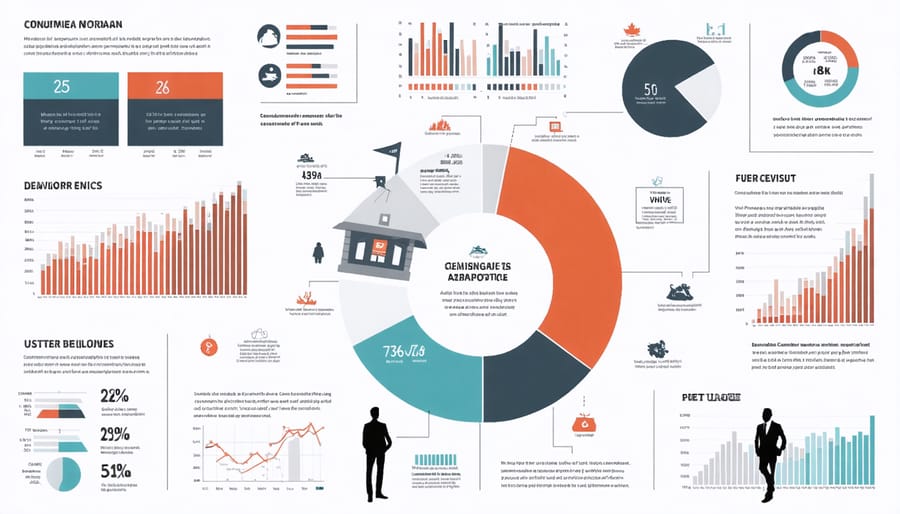
A thorough competitive landscape analysis forms the cornerstone of effective market research, helping businesses identify opportunities and potential challenges in their target market. Canadian companies that excel in market entry typically begin by mapping out key competitors, their market share, and distinctive value propositions.
Start by identifying direct competitors who offer similar products or services, as well as indirect competitors who might fulfill the same customer needs through alternative solutions. Canadian market leaders have demonstrated that success often comes from studying successful market penetration examples and adapting strategies to local conditions.
Consider these key analysis components:
– Market positioning and brand perception
– Pricing strategies and cost structures
– Distribution channels and partnerships
– Product features and service offerings
– Customer satisfaction levels and loyalty programs
Industry expert Sarah Thompson of the Canadian Marketing Association suggests, “Companies should focus on identifying gaps in competitor offerings and understanding what drives customer choice in their sector.”
Remember to assess both established players and emerging competitors, as the Canadian market landscape continues to evolve with technological advancement and changing consumer preferences. This analysis should inform your unique value proposition and help identify sustainable competitive advantages that will resonate with your target market.
Regulatory Environment
Understanding Canada’s regulatory environment is crucial for successful market research and business operations. The Canadian marketplace is governed by federal, provincial, and territorial regulations that protect consumers, ensure fair competition, and maintain market integrity.
Key federal bodies like Industry Canada and the Competition Bureau oversee market activities and enforce compliance with the Competition Act. This legislation promotes fair business practices and prevents anti-competitive behavior that could skew market research findings.
When conducting market research, businesses must comply with privacy laws, particularly the Personal Information Protection and Electronic Documents Act (PIPEDA). This affects how companies collect, use, and store consumer data during research activities.
Industry-specific regulations may also impact market research strategies. For example, financial services research must align with Financial Consumer Agency of Canada (FCAC) guidelines, while healthcare market research needs to consider Health Canada regulations.
Provincial variations in business regulations can affect market research approaches. Ontario’s Consumer Protection Act differs from Quebec’s Consumer Protection Act, requiring researchers to adjust their methodologies accordingly.
Leading market research firm Ipsos notes that maintaining regulatory compliance while conducting research in Canada has become increasingly important, especially with the rise of digital data collection methods. Successful companies typically establish clear compliance protocols and regularly update their research practices to align with evolving regulations.
Remember to consult legal experts familiar with Canadian business law when designing market research strategies to ensure full regulatory compliance.
Implementing Research Findings
Creating Actionable Insights
Transforming raw market research data into actionable insights requires a systematic approach that drives measurable business outcomes. Successful Canadian companies excel at this process by following a structured methodology that connects data points to strategic decisions.
Start by identifying clear patterns and trends in your research data, focusing on those that directly impact your business objectives. For organizations seeking competitive advantage strategies, this means prioritizing insights that reveal market gaps or untapped opportunities.
Consider the example of Vancouver-based athleisure brand Lululemon, which leveraged customer behavior insights to expand its product line successfully. By analyzing market research data, they identified a growing demand for men’s athletic wear and strategically diversified their offerings.
To create actionable insights:
1. Prioritize findings based on business impact and feasibility
2. Develop specific, measurable recommendations
3. Create timeline-based implementation plans
4. Assign clear ownership and accountability
5. Establish success metrics and monitoring systems
Remember to validate your insights through multiple data sources and stakeholder feedback. This approach ensures that your strategic decisions are well-founded and aligned with market realities. Regular review and adjustment of your action plans keep them relevant and responsive to changing market conditions.

Risk Mitigation Strategies
Effective risk mitigation in market research begins with systematic identification and analysis of potential challenges before market entry. Canadian businesses can protect their investments by implementing comprehensive research strategies that address both internal and external risks.
Start by conducting thorough competitive analysis to understand market dynamics and potential barriers. This includes evaluating existing players, their market share, and competitive advantages. Research shows that Canadian companies who invest time in competitor analysis are 60% more likely to achieve successful market entry.
Create detailed consumer behavior profiles to identify potential adoption challenges. Focus groups and surveys can reveal critical insights about customer preferences and potential resistance points. For instance, Vancouver-based tech startup CloudMatrix successfully pivoted their product features based on preliminary market feedback, avoiding a costly market misalignment.
Economic and regulatory risks should be assessed through consultation with industry experts and regulatory bodies. Consider partnering with local market research firms who understand regional nuances. As noted by the Canadian Chamber of Commerce, businesses that engage local expertise reduce their risk exposure by approximately 40%.
Develop contingency plans for identified risks, including market entry timing adjustments, product modifications, or alternative distribution strategies. Regular monitoring and updating of risk assessments ensures strategies remain relevant and effective.
Remember to document all findings systematically and maintain flexible response protocols. This approach allows for quick adaptation to changing market conditions while maintaining strategic focus.
Strategic market research stands as a cornerstone of successful business expansion and market entry in Canada’s dynamic business landscape. Throughout this guide, we’ve explored the essential components that make market research not just informative, but truly strategic and actionable.
Remember that effective market research is an ongoing process rather than a one-time effort. By consistently monitoring market trends, consumer behavior, and competitive landscapes, Canadian businesses can maintain their competitive edge and adapt to changing market conditions.
The success stories of companies like Shopify and Canada Goose demonstrate how thorough market research can lead to remarkable growth and international success. These companies leveraged data-driven insights to make informed decisions, ultimately building global brands while maintaining strong Canadian roots.
To implement strategic market research effectively in your organization:
– Start with clear, measurable objectives
– Utilize both primary and secondary research methods
– Analyze data through multiple lenses
– Create actionable insights from your findings
– Regular review and update your research
The investment in strategic market research consistently proves its value through better decision-making, reduced risks, and improved market positioning. As the Canadian market continues to evolve, businesses that maintain a strong commitment to research-based strategy will be better positioned to identify opportunities and navigate challenges.
Take the first step today by developing your market research plan. Whether you’re a startup preparing for launch or an established business planning expansion, the insights gained through strategic market research will illuminate your path to success in the Canadian marketplace.