

Sustainability isn’t just a buzzword—it’s reshaping the modern marketplace with unprecedented force. Recent global studies reveal that 85% of consumers have shifted their purchasing behavior towards more sustainable choices in the past five years, with Canadian shoppers leading this transformation. For business leaders, this represents both a challenge and an unprecedented opportunity.
A 2023 McKinsey survey shows that 66% of all consumers, and 75% of millennial consumers, consider sustainability when making a purchase. In Canada specifically, 78% of consumers rank environmental impact as a top factor in their buying decisions, signaling a clear mandate for businesses to adapt. This shift isn’t just about environmental consciousness—it’s about market survival and competitive advantage in an increasingly eco-aware economy.
For Canadian businesses, understanding these statistics isn’t optional—it’s essential for future-proofing operations and capturing market share in an evolving landscape where consumer values directly impact bottom lines. The question isn’t whether sustainability matters to consumers, but how businesses can effectively respond to this growing demand.
Current State of Sustainable Consumer Behavior in Canada
Key Sustainability Statistics
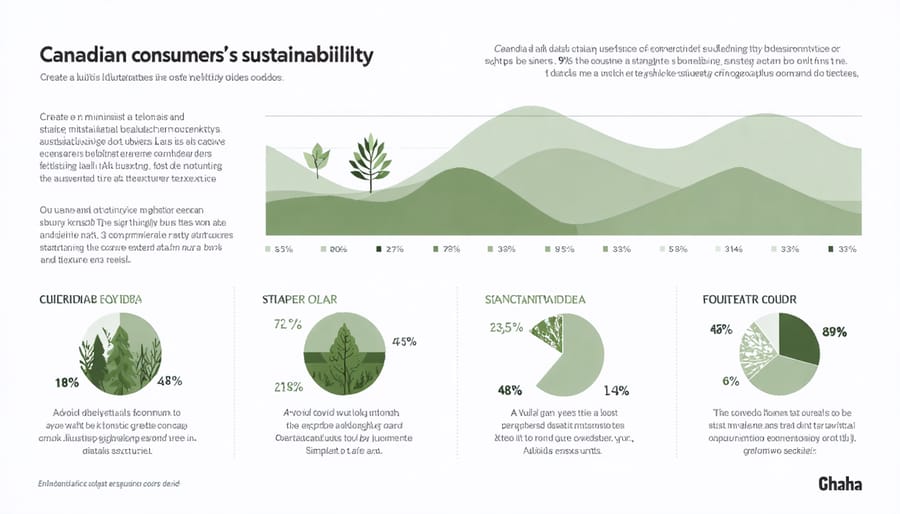
Recent market research reveals compelling evidence of growing consumer commitment to sustainability. A significant 78% of Canadian consumers consider the environmental impact of consumer choices when making purchasing decisions, with this percentage rising to 85% among millennials and Gen Z demographics.
Key findings show that 73% of consumers are willing to pay more for sustainable products, with an average premium tolerance of 10-15%. Urban consumers demonstrate the highest sustainability awareness, with 82% actively seeking eco-friendly alternatives. Women lead in sustainable purchasing decisions at 76%, compared to 69% of men.
Age-wise, 88% of consumers aged 18-34 prioritize sustainability in their shopping choices, while 71% of those 55 and older consider it important. Income levels also play a role, with 80% of middle to high-income consumers more likely to choose sustainable options.
Regional variations exist across Canada, with British Columbia showing the highest sustainability consciousness at 84%, followed by Ontario at 79% and Quebec at 77%. These statistics demonstrate a clear shift toward sustainability-driven consumption patterns across all demographic segments.
Consumer Purchasing Patterns
Recent market research reveals distinct patterns in how sustainability influences purchasing decisions across various sectors. In the food and beverage industry, 73% of Canadian consumers actively seek products with eco-friendly packaging, while 68% prefer locally sourced items. The fashion sector shows similar trends, with 65% of shoppers willing to pay more for sustainable clothing options.
Studies by Retail Council of Canada indicate that sustainability considerations most strongly impact purchasing decisions in household goods (78%), personal care products (72%), and electronics (61%). However, price sensitivity remains a factor, with consumers typically accepting a 10-15% premium for sustainable alternatives.
Generation Z and Millennials lead this shift, with 82% reporting that environmental impact significantly influences their buying choices. This trend is particularly evident in urban centers like Toronto and Vancouver, where sustainable product sales have grown by 24% annually since 2020.
Industry experts note that transparency in sustainability claims strongly affects purchasing behavior, with 67% of consumers researching company environmental practices before making significant purchases. This demonstrates the growing importance of authentic sustainability messaging in influencing consumer choices.
What Drives Sustainable Purchase Decisions
Environmental Awareness
Recent studies reveal a significant shift in how sustainability drives consumer decisions, with environmental consciousness playing an increasingly crucial role in purchase behavior. According to Environmental Defence Canada, 78% of Canadian consumers now actively consider environmental impact when making buying decisions, marking a 23% increase from just five years ago.
This heightened awareness stems from multiple factors, including increased media coverage of climate change, visible environmental degradation, and better access to information about corporate environmental practices. Canadian consumers are particularly attuned to issues like plastic pollution, carbon emissions, and sustainable packaging, with 82% reporting they’re willing to pay more for environmentally responsible products.
Leading Canadian retailers like Mountain Equipment Co-op (MEC) and Lululemon have successfully capitalized on this trend by implementing transparent sustainability practices. Their success demonstrates that environmental consciousness has evolved from a niche concern to a mainstream consideration.
Environmental awareness varies by demographic, with millennials and Gen Z showing the strongest commitment to sustainable purchasing. These groups are 45% more likely to research a company’s environmental practices before making significant purchases, according to the Retail Council of Canada. This trend indicates that environmental consciousness in consumer behavior will likely continue to grow as these generations gain more purchasing power.
Price Sensitivity vs. Sustainability
Recent market research reveals a complex relationship between consumer attitudes toward sustainability and their willingness to pay premium prices. Studies show that 67% of Canadian consumers express interest in sustainable products, but only 38% consistently follow through with purchases when faced with higher costs.
A 2023 survey by Deloitte Canada found that while 72% of consumers believe environmental responsibility is important, price remains the primary decision factor for 83% of shoppers. The sweet spot for sustainable product premiums appears to be between 10-15% above conventional alternatives, with consumer acceptance dropping significantly beyond this threshold.
However, certain demographic segments show higher price tolerance for sustainable options. Millennials and Gen Z consumers are willing to pay up to 20% more for environmentally responsible products, particularly in categories like personal care, food, and fashion. Urban professionals in cities like Toronto, Vancouver, and Montreal demonstrate the highest willingness to pay for sustainable alternatives.
Canadian retailers like MEC and Lululemon have successfully balanced sustainability with pricing by clearly communicating the long-term value proposition of their eco-friendly products. Their experience shows that consumers are more likely to accept premium pricing when brands effectively demonstrate tangible environmental benefits and superior product quality.
For businesses, this suggests a strategic approach: focus on incremental sustainability improvements while maintaining competitive pricing, rather than pursuing radical eco-innovations that could price out mainstream consumers.

Business Opportunities in Sustainable Markets
Market Growth Potential
The sustainable products market continues to demonstrate remarkable growth potential, with projections indicating a compound annual growth rate of 8.6% from 2023 to 2028. Canadian businesses are particularly well-positioned to capitalize on this trend, as domestic consumers increasingly prioritize eco-friendly options across various sectors.
Key growth areas include sustainable packaging, which is expected to reach $305.31 billion globally by 2027, with Canadian manufacturers leading innovations in biodegradable materials. The organic food sector in Canada has shown consistent annual growth of 10.4%, demonstrating strong consumer demand for environmentally responsible products.
According to the Business Development Bank of Canada, 85% of Canadian consumers actively seek out sustainable products, representing a significant market opportunity. Sectors showing particularly strong growth include sustainable fashion, clean energy solutions, and eco-friendly home products.
Small and medium-sized enterprises are finding success by incorporating sustainability into their business models. For instance, Vancouver-based Loop Recycled Products saw a 200% revenue increase after launching their recycled packaging line, highlighting the commercial viability of sustainable initiatives.
Success Stories
Among successful Canadian brands, several companies have demonstrated remarkable results by embracing sustainability initiatives. Lululemon’s commitment to sustainable materials and ethical manufacturing has resulted in a 20% increase in customer loyalty scores since 2019. The outdoor retailer MEC (Mountain Equipment Co-op) saw a 15% growth in membership after strengthening its circular economy programs and implementing a robust gear recycling initiative.
Vancouver-based Nature’s Path Foods reported a 25% increase in market share after transitioning to 100% organic ingredients and compostable packaging. Similarly, ATTITUDE, a Montreal-based personal care company, experienced a 30% year-over-year growth by focusing on plastic-free packaging and natural ingredients.
These success stories reflect a broader trend: businesses that authentically embrace sustainability not only contribute to environmental conservation but also achieve significant business growth. The key factor in their success has been transparency and genuine commitment to sustainable practices, rather than superficial “greenwashing” attempts.

Implementation Strategies
Businesses can effectively integrate sustainability practices through several proven strategies. Start by conducting a thorough sustainability audit to identify areas for improvement in your operations. Implement a clear measurement system to track progress and set realistic, achievable goals.
Consider adopting circular economy principles by minimizing waste, reusing materials, and redesigning products for longer lifecycles. Canadian retailer MEC demonstrates this effectively through their gear recycling program and sustainable product design initiatives.
Engage employees through sustainability training programs and create dedicated green teams to drive initiatives forward. Communicate your sustainability efforts transparently to consumers through clear labeling, detailed reporting, and authentic marketing campaigns.
Partner with sustainable suppliers and verify their environmental credentials. Many successful Canadian businesses have found success by joining sustainability-focused business networks and seeking certification from recognized environmental organizations.
Start small and scale gradually. Focus on quick wins like reducing packaging waste or implementing energy-efficient solutions before tackling larger initiatives. Remember to document and share your sustainability journey with customers, as transparency builds trust and strengthens brand loyalty.
The growing momentum behind sustainable consumerism presents both opportunities and imperatives for Canadian businesses. Research consistently shows that between 60-80% of consumers consider sustainability in their purchasing decisions, with this percentage steadily increasing year over year. This trend is particularly pronounced among younger demographics, suggesting that sustainability will become even more crucial for business success in the coming years.
Canadian businesses that have embraced sustainability initiatives are already seeing positive results, with many reporting increased customer loyalty, enhanced brand reputation, and improved market share. Companies like Lululemon and Canada Goose have successfully integrated sustainable practices into their operations while maintaining profitability and market leadership.
Looking ahead, experts predict that consumer interest in sustainability will continue to grow, driven by increasing environmental awareness, regulatory changes, and technological advancements. Businesses that proactively adapt their practices to meet these evolving consumer preferences will be better positioned for long-term success.
To remain competitive, Canadian businesses should focus on transparent communication about their sustainability efforts, authentic implementation of eco-friendly practices, and continuous innovation in sustainable solutions. The key to success lies in finding the balance between environmental responsibility and economic viability while meeting the growing consumer demand for sustainable products and services.
As we move forward, the question is no longer whether consumers care about sustainability, but how businesses can best respond to and benefit from this established market reality.