

Renewable energy adoption is surging at an unprecedented rate across the globe, with investments reaching record highs of $500 billion in 2022. This remarkable growth, driven by technological advances and falling costs, positions clean energy as a cornerstone of our sustainable future. Canadian innovation hubs are leading this transformation, pioneering breakthroughs in solar efficiency and wind power integration that have reduced installation costs by 70% over the past decade.
Recent data from the International Energy Agency confirms that renewable sources now account for over 30% of global electricity generation, with solar and wind installations outpacing all other forms of power generation combined. This shift isn’t just environmental – it’s economic. Major corporations and utilities are increasingly choosing renewables as their primary energy source, driven by competitive pricing and enhanced grid reliability.
The momentum is clear: renewable energy isn’t just increasing – it’s accelerating at a pace that’s reshaping our energy landscape and creating unprecedented opportunities for sustainable development.
The Rise of Canadian Renewable Energy Innovation Hubs
Strategic Locations and Regional Impact
Several key innovation hubs across Canada are driving remarkable growth in renewable energy adoption. Ontario’s Waterloo Region has emerged as a leading cleantech cluster, with over 90 companies focused on renewable energy solutions. The region has seen a 45% increase in renewable energy projects since 2019.
British Columbia’s Clean Energy Research Centre in Vancouver serves as another crucial hub, particularly in solar and wind technology development. Their initiatives have contributed to a 30% rise in provincial renewable energy capacity over the past three years.
In Quebec, the Montreal-based Sustainable Energy Innovation Centre has facilitated partnerships between academia and industry, resulting in breakthrough energy storage solutions. The centre has helped launch 25 new renewable energy startups since 2020.
Alberta’s Clean Resource Innovation Network has been instrumental in transitioning traditional energy expertise toward renewable solutions. Their efforts have attracted over $2 billion in clean energy investments to the region.
These strategic locations have created a ripple effect, stimulating economic growth and environmental innovation in surrounding communities while positioning Canada as a global leader in renewable energy development.
Public-Private Partnership Success Stories
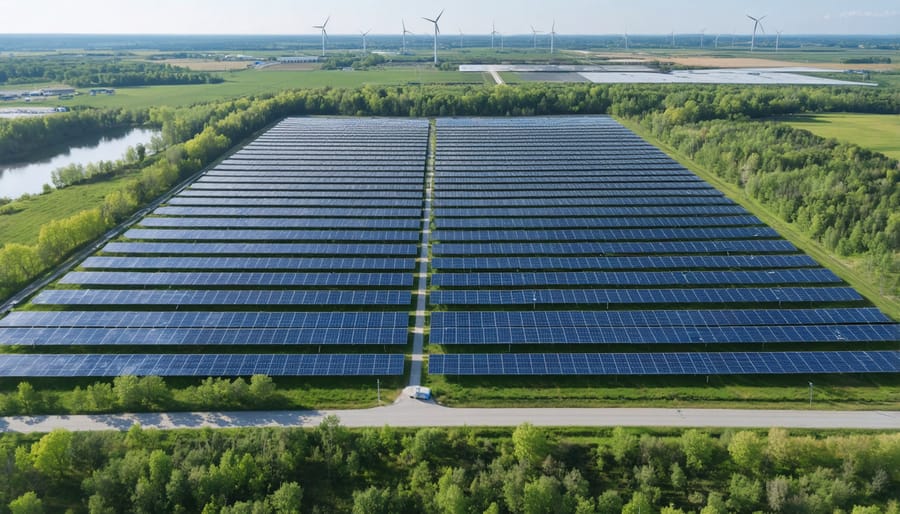
Canada’s renewable energy sector has witnessed remarkable success through strategic public-private partnerships. The Drake Landing Solar Community in Alberta stands as a prime example, where government funding collaborated with private sector innovation to create North America’s first solar-powered subdivision, achieving 90% solar heating efficiency.
In Ontario, the Bruce Power-Indigenous Partnership Program demonstrates how utility companies and First Nations communities can work together effectively. This collaboration has generated over 1,000 jobs while expanding clean energy infrastructure across the region.
The Smart Grid Innovation Network, a partnership between NB Power, Siemens, and the University of New Brunswick, showcases how academic institutions, utilities, and technology companies can drive innovation. Their joint efforts have accelerated the development of advanced grid technologies and energy storage solutions.
British Columbia’s Renewable Energy Hub, a collaboration between BC Hydro and various clean tech companies, has successfully integrated multiple renewable sources into the provincial grid. This partnership has attracted over $2 billion in private investment and created a model for future clean energy initiatives across the country.
Measurable Growth in Renewable Energy Production
Current Production Statistics
Recent data from the International Renewable Energy Agency (IRENA) shows remarkable growth in renewable energy production worldwide, with a significant uptick in Canadian markets. In 2023, renewable energy sources accounted for over 30% of global electricity generation, marking a substantial increase from previous years. These innovations are actively transforming Canada’s power grid and reshaping our energy landscape.
Canadian renewable energy capacity reached new heights in 2023, with wind and solar installations leading the charge. Wind power capacity expanded by 15% year-over-year, while solar installations grew by an impressive 25%. Hydroelectric power, traditionally Canada’s strongest renewable sector, maintains its position with 60% of the country’s electricity generation.
According to Clean Energy Canada, investment in renewable projects exceeded $10 billion in 2023, creating thousands of new jobs across the country. British Columbia and Ontario lead provincial growth, with Alberta showing the fastest acceleration in new installations. Quebec continues to maximize its hydroelectric potential, exporting clean energy to neighboring regions.
The cost of renewable technologies continues to decrease, with utility-scale solar and wind projects now consistently outcompeting fossil fuel alternatives. Industry experts project this trend will accelerate, with storage solutions and smart grid technologies enabling even greater renewable energy integration.
Year-over-Year Growth Trends
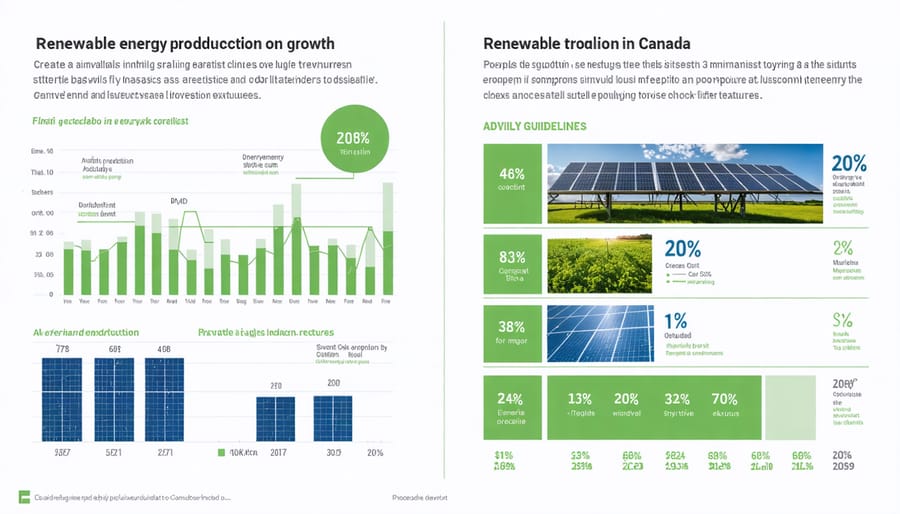
The renewable energy sector continues to demonstrate remarkable year-over-year growth, with Canada emerging as a global leader in clean energy adoption. Recent data from Natural Resources Canada shows that renewable energy sources now account for 18.9% of Canada’s total primary energy supply, marking a significant increase from previous years.
Wind and solar installations have seen particularly impressive growth rates, with annual capacity additions increasing by 35% in 2022 compared to 2021. Major projects in Alberta and Ontario have contributed significantly to this trend, with Alberta adding over 1,000 megawatts of renewable capacity in the past year alone.
Investment patterns reflect this upward trajectory, with Canadian clean technology investments reaching $10.3 billion in 2022, representing a 75% increase from 2020. Industry experts project this growth to accelerate, forecasting renewable energy to supply 30% of Canada’s energy needs by 2030.
The Canada Infrastructure Bank has committed $5 billion towards green infrastructure projects, further supporting this positive trend. Notable success stories include Quebec’s hydroelectric expansion and Nova Scotia’s rapid advancement in offshore wind development.
Employment in the renewable sector has grown by 25% annually since 2020, creating thousands of new jobs across the country. This trend is expected to continue as more provinces strengthen their commitment to clean energy targets and international partnerships drive further innovation and expansion in the sector.
Innovation Hub Success Factors
Research and Development Infrastructure
Canada’s commitment to renewable energy is evident in its expanding research and development infrastructure. Major innovation hubs across the country are driving significant breakthroughs in wind energy technology innovations and other renewable solutions. The National Research Council (NRC) has established dedicated facilities in multiple provinces, with state-of-the-art laboratories supporting clean energy research.
Notable developments include the Wind Engineering Research Facility in Ottawa and the Marine Renewable Energy Technology Centre in Nova Scotia. These facilities are equipped with advanced testing equipment, simulation capabilities, and collaborative spaces that bring together researchers, industry experts, and entrepreneurs.
Private sector investment in R&D infrastructure has also surged, with companies like Hydrogenics and Canadian Solar establishing world-class research centers. Universities across Canada have expanded their renewable energy research facilities, with the University of Toronto’s Clean Energy Research Lab and the University of British Columbia’s Clean Energy Research Centre leading groundbreaking studies.
These facilities are supported by government initiatives like the Clean Growth Hub, which provides funding and resources for renewable energy innovation. The infrastructure network enables rapid prototyping, testing, and commercialization of new technologies, positioning Canada as a global leader in renewable energy development.

Talent Development and Retention
The renewable energy sector’s rapid growth has created a significant demand for skilled professionals, driving innovative talent development initiatives across Canada. Leading companies are partnering with educational institutions to create specialized training programs, ensuring a steady pipeline of qualified workers for solar, wind, and other renewable energy projects.
Major renewable energy employers report investing heavily in employee development, with many offering comprehensive training programs and career advancement opportunities. The Canadian Renewable Energy Association notes that companies providing clear growth pathways and ongoing professional development see 40% higher retention rates compared to industry averages.
Success stories include Alberta’s Renewable Energy Training Initiative, which has trained over 2,000 professionals in the past three years, with 85% securing positions in the sector within six months of completion. In Ontario, the Green Careers Network has successfully facilitated the transition of 1,500 workers from traditional energy sectors to renewable energy roles through targeted upskilling programs.
Industry leaders are also focusing on diversity and inclusion, with programs specifically designed to attract underrepresented groups. These initiatives have led to a 30% increase in workforce diversity over the past five years. Companies are implementing mentorship programs, flexible work arrangements, and competitive benefits packages to retain top talent and maintain their competitive edge in this rapidly evolving sector.
The trajectory of renewable energy growth in Canada and globally shows unmistakable momentum, supported by compelling evidence and market trends. Recent data indicates that renewable energy sources are not just growing but accelerating, with installations of solar and wind power reaching record levels year after year. Canadian provinces like Ontario, Alberta, and British Columbia continue to lead the charge, setting ambitious targets and achieving significant milestones in renewable energy adoption.
Investment in renewable technologies has become increasingly attractive, with costs continuing to decline while efficiency improves. Major Canadian corporations and institutional investors are redirecting substantial capital toward renewable projects, recognizing both the environmental benefits and strong return potential. This shift is further reinforced by supportive government policies and growing public demand for clean energy solutions.
Looking ahead, the future of renewable energy appears exceptionally promising. Industry experts project that by 2030, renewables could provide up to 40% of Canada’s total energy needs, creating thousands of new jobs and driving economic growth across the country. Technological advancements in energy storage, smart grid systems, and improved transmission infrastructure are addressing historical challenges and paving the way for even broader adoption.
The transition to renewable energy is no longer just an environmental imperative but a compelling business opportunity. As innovation continues and economies of scale improve, the renewable energy sector is positioned to play an increasingly central role in Canada’s energy landscape. This growth trajectory, supported by strong market fundamentals and policy frameworks, suggests that renewable energy will remain one of the most dynamic and promising sectors for investment and development in the coming decades.