

Transform your career trajectory and drive meaningful change through an MBA in sustainable business – a credential that’s rapidly becoming essential for forward-thinking leaders in today’s environmentally conscious market. As organizations worldwide pivot towards sustainable business practices, professionals equipped with specialized knowledge in sustainability management and green innovation are increasingly valuable. Canadian MBA programs focusing on sustainability offer a unique blend of rigorous business fundamentals with cutting-edge environmental stewardship principles, preparing graduates to tackle complex challenges while driving profitable, purpose-driven initiatives. From cleantech startups to corporate sustainability transformations, the opportunities for sustainability-focused MBA graduates are expanding exponentially, with median salaries 20% higher than traditional MBA roles. This specialized education empowers leaders to create lasting impact while capitalizing on the $23 trillion global sustainable business opportunity projected through 2025.
The Evolution of Sustainable Business Education in Canada

Industry Demand for Sustainable Business Leaders
The demand for sustainability-focused business leaders has surged dramatically across Canadian industries. Recent market analysis shows that 78% of major Canadian corporations now actively seek executives with sustainable business expertise, reflecting a fundamental shift in corporate priorities.
Leading companies like TD Bank, Shopify, and TELUS specifically require sustainability competencies when hiring for senior positions. This trend extends beyond traditional environmental sectors, with manufacturing, retail, and financial services increasingly valuing sustainable business acumen.
According to the Canadian Sustainability Leadership Survey, professionals with MBA credentials in sustainable business command 23% higher salaries compared to traditional MBA graduates. McKinsey reports that 85% of global companies consider sustainability expertise essential for C-suite positions.
Industry experts predict this demand will continue growing as organizations face mounting pressure to address climate change, meet ESG requirements, and adapt to stricter environmental regulations. For professionals seeking leadership roles, sustainable business expertise has evolved from a specialty qualification to a core competency.
Key Sustainability Competencies
MBA programs in sustainable business equip leaders with essential competencies required for driving organizational sustainability. Core skills include strategic sustainability planning, environmental impact assessment, and stakeholder engagement. Students develop expertise in ESG (Environmental, Social, and Governance) reporting, circular economy principles, and sustainable supply chain management.
Critical thinking and systems thinking are fundamental, enabling graduates to analyze complex sustainability challenges and develop innovative solutions. Change management abilities help leaders implement green initiatives and transform organizational culture. Financial acumen focuses on both traditional metrics and triple bottom line accounting, ensuring profitability alongside social and environmental performance.
Program participants also master sustainable innovation strategies, regulatory compliance, and risk management specific to environmental concerns. Communication skills are emphasized throughout, preparing graduates to effectively engage with diverse stakeholders and advocate for sustainability initiatives at all organizational levels.
These competencies position graduates to lead their organizations toward more sustainable futures while maintaining competitive advantage in an evolving business landscape.
Leading Canadian MBA Programs with Sustainability Focus

Program Features and Specializations
MBA programs in sustainable business typically offer a comprehensive curriculum that balances traditional business fundamentals with specialized sustainability courses. Core modules include sustainable supply chain management, environmental accounting, corporate social responsibility, and green innovation strategies. Students can choose specializations in areas such as renewable energy management, circular economy practices, or sustainable finance.
Leading Canadian business schools offer unique program features like hands-on consulting projects with environmentally conscious companies, sustainability-focused case competitions, and green business incubator programs. Many programs incorporate field studies at successful sustainable enterprises and collaborative projects with environmental organizations.
The curriculum often includes practical elements such as carbon footprint analysis, ESG reporting, and sustainable business model development. Students gain expertise in impact measurement, stakeholder engagement, and green marketing strategies. Advanced courses cover topics like clean technology innovation, sustainable urban development, and ethical leadership.
International study options allow students to explore global sustainability practices, while industry partnerships provide networking opportunities with sustainability leaders. Programs typically conclude with a capstone project where students develop sustainable business solutions for real-world challenges.
Industry Partnerships and Real-world Projects
MBA programs in sustainable business are actively transforming business leadership through robust industry partnerships and hands-on projects. Leading Canadian institutions collaborate with organizations like Sustainable Development Technology Canada (SDTC) and the Canada Green Building Council to provide students with real-world consulting opportunities.
Students work directly with companies implementing sustainability initiatives, from developing renewable energy strategies for major utilities to creating circular economy solutions for manufacturing firms. For instance, MBA candidates at York University’s Schulich School of Business recently partnered with Tesla to optimize their supply chain sustainability in Canada.
These partnerships extend beyond traditional consulting projects. Students often participate in sustainability-focused internships, mentorship programs, and industry workshops. Notable Canadian companies like Maple Leaf Foods and BMO offer specialized rotational programs for sustainable business MBA graduates, providing invaluable experience in implementing environmental, social, and governance (ESG) initiatives.
The practical experience gained through these partnerships helps students build professional networks while applying classroom learning to solve real sustainability challenges facing Canadian businesses today.
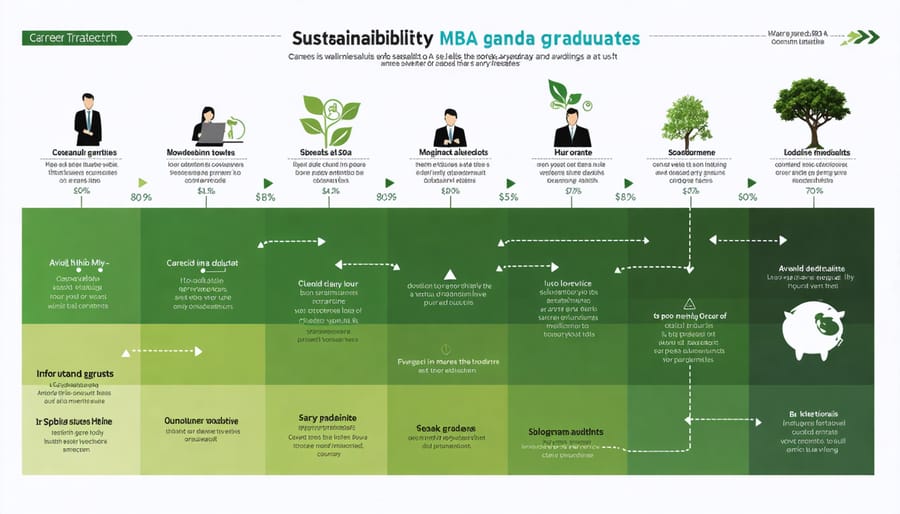
Career Impact and Opportunities
Success Stories and Alumni Insights
Sarah Thompson, a graduate of Schulich School of Business’s MBA program, now leads sustainability initiatives at TD Bank, implementing green financing solutions that have mobilized over $100M in sustainable investments. At Vancouver-based Lululemon, MBA alumnus Michael Chen developed a circular economy program that reduced packaging waste by 45% while increasing customer loyalty.
Jessica Rodriguez, who completed her MBA at McGill’s Desautels Faculty of Management, founded GreenTech Solutions, a consulting firm helping small businesses transition to sustainable operations. Her company has assisted over 200 Canadian businesses in reducing their carbon footprint.
“My MBA in sustainable business provided the perfect blend of strategic thinking and environmental expertise,” shares David O’Connor, Chief Sustainability Officer at Rogers Communications. “It equipped me with tools to drive meaningful change while maintaining profitability.”
These alumni demonstrate how combining business acumen with sustainability knowledge creates impactful leadership opportunities across various sectors.
Emerging Roles in Sustainable Business
The sustainable business sector is experiencing rapid growth, creating exciting new career opportunities for MBA graduates. Sustainability managers and directors are increasingly in demand across major Canadian corporations, with organizations like TD Bank and Loblaws actively recruiting for these positions. Chief Sustainability Officers (CSOs) are becoming standard in C-suite structures, offering six-figure salaries and strategic influence.
Environmental, Social, and Governance (ESG) consultants are particularly sought after, helping companies develop and implement sustainable practices while ensuring regulatory compliance. Impact investment managers and sustainable supply chain specialists represent emerging roles that combine traditional business expertise with environmental consciousness.
Start-ups and social enterprises are also creating opportunities for sustainable business graduates to serve as founders, advisors, or innovation directors. Government agencies and non-profits increasingly seek MBA-educated professionals to lead climate action initiatives and sustainable development programs, offering competitive compensation packages and meaningful work opportunities.
Return on Investment
Investing in a sustainability-focused MBA demonstrates compelling returns, both financially and professionally. Recent studies show that graduates from sustainability-oriented MBA programs in Canada command average starting salaries 15-20% higher than traditional MBA graduates. This premium reflects the growing market demand for leaders who can drive sustainability-driven business success while maintaining profitability.
Canadian companies increasingly value professionals who combine core business acumen with sustainability expertise. According to the Canadian Association of Graduate Studies, 78% of sustainability MBA graduates secure relevant positions within six months of graduation, with many advancing to senior leadership roles within three years.
The investment typically ranges from $40,000 to $120,000 for top Canadian programs, with an average payback period of 3.5 years. Beyond monetary returns, graduates report enhanced job satisfaction, broader professional networks, and greater impact potential. Many alumni have successfully launched sustainable ventures or transformed existing businesses, generating both financial returns and positive environmental impact.
Career advancement opportunities span multiple sectors, including renewable energy, sustainable finance, corporate sustainability, and consulting. Notably, sustainability MBA graduates often secure positions in Canada’s growing cleantech sector, where average executive compensation packages exceed $180,000 annually.
An MBA in sustainable business represents a powerful investment in both professional growth and environmental stewardship. As Canadian businesses increasingly prioritize sustainability, graduates with this specialized expertise are uniquely positioned to lead organizational transformation and drive positive change. The future outlook for sustainable business leaders remains exceptionally bright, with growing demand across industries for professionals who can balance profit with purpose. Recent market trends indicate that companies with strong environmental, social, and governance (ESG) practices outperform their peers, suggesting continued expansion of opportunities in this field. As sustainability becomes central to business strategy, these MBA programs will continue evolving to address emerging challenges and opportunities. For professionals seeking to make a meaningful impact while advancing their careers, a sustainable business MBA offers a compelling pathway to achieve both personal and planetary prosperity.