

A cloud infrastructure strategy is a comprehensive plan that defines how an organization will design, deploy, and manage its computing resources across cloud platforms to achieve specific business objectives while optimizing cost, performance, and security. For Canadian businesses competing in 2026, this isn’t an IT project. It’s a fundamental business decision that determines operational agility, data sovereignty compliance, and market responsiveness.
The stakes are substantial. Organizations with deliberate cloud strategies report 30-40% lower infrastructure costs and faster time-to-market compared to those migrating without clear architectural principles. Yet many Canadian enterprises still approach cloud adoption reactively, moving workloads without considering regulatory requirements under PIPEDA, cross-border data residency rules, or how their infrastructure choices affect their competitive edge.
Toronto-based fintech Wealthsimple demonstrated the power of strategic cloud planning when it built a multi-region infrastructure that balanced performance with Canadian data residency requirements. Their approach reduced latency for customers while maintaining regulatory compliance, contributing to their expansion across the country.
This article breaks down what cloud infrastructure strategy actually entails: the operational mechanics of planning and implementation, the core components you’ll need to address, and practical applications tailored to Canadian regulatory and business contexts. Whether you’re evaluating your first cloud migration or refining an existing hybrid environment, you’ll find actionable frameworks to make informed decisions about architecture, vendor selection, and governance that align technology investments with business outcomes.
What Cloud Infrastructure Strategy Means for Canadian Businesses
A cloud infrastructure strategy is a comprehensive plan that defines how an organization will use cloud computing resources to support its business goals. Rather than moving workloads to the cloud piecemeal or reacting to immediate needs, this approach establishes a deliberate framework for selecting cloud services, managing data, ensuring security, and optimizing costs across the entire technology environment.
The difference between strategic cloud adoption and ad hoc migration is significant. Ad hoc approaches often lead to sprawl, multiple disconnected cloud services, redundant systems, security gaps, and unpredictable costs. A proper strategy creates alignment: IT investments directly support business objectives like faster product launches, improved customer experiences, or expansion into new markets. For Canadian enterprises navigating data sovereignty requirements and competitive pressure from both domestic and international players, this alignment becomes critical.
- Cloud Infrastructure
- The combination of hardware, virtualization, storage, and networking resources delivered as on-demand services over the internet, replacing or augmenting traditional on-premises data centers.
- Infrastructure Strategy
- A deliberate plan outlining how technology resources will be acquired, deployed, secured, and managed to achieve specific business outcomes and competitive advantages.
- Hybrid Cloud
- An architecture combining private cloud or on-premises infrastructure with public cloud services, allowing workloads to move between environments based on requirements.
- Multi-Cloud
- The use of cloud services from multiple providers simultaneously, reducing vendor lock-in and enabling organizations to select best-of-breed solutions for different workloads.
- Workload Optimization
- The process of matching specific applications and data sets to the most appropriate and cost-effective cloud environment based on performance needs, compliance requirements, and budget constraints.
At its core, a cloud infrastructure strategy answers fundamental questions: Which workloads belong in the cloud? What governance ensures compliance with Canadian privacy regulations? How will the organization balance cost, performance, and security? The strategy becomes the roadmap that prevents reactive technology decisions and enables confident, forward-looking IT planning.
How Cloud Infrastructure Strategy Works

Assessment and Planning Phase
The assessment and planning phase begins with a comprehensive inventory of your current infrastructure. Document every application, database, server, and integration point. Most Canadian enterprises discover shadow IT, cloud services purchased by departments without central oversight, consuming 20-30% of their actual cloud spend.
Next, map these technical assets to business objectives. Which systems support revenue generation? Which handle sensitive customer data? Which applications face compliance requirements under Canadian privacy laws? This business-aligned view reveals which workloads deserve migration priority versus those better left on-premises.
Cost-benefit analysis follows. Calculate total cost of ownership for current infrastructure: hardware, software licenses, data center space, power, cooling, maintenance contracts, and IT staff time. Compare against projected cloud costs using actual usage patterns, not vendor estimates. Factor in Canadian data residency requirements, storing data in Canadian regions typically costs 10-15% more than US regions but eliminates cross-border compliance risks.
Document dependencies between systems. Applications relying on low-latency connections to on-premises databases may need hybrid architecture rather than full cloud migration. This technical mapping prevents costly mistakes during implementation.
Implementation and Governance
Once strategic planning concludes, enterprises must translate their cloud infrastructure strategy into concrete deployment decisions, security protocols, and governance frameworks. This implementation phase begins with selecting specific cloud providers and services that align with documented business requirements and technical specifications. Canadian organizations typically establish a formal decision matrix that evaluates vendors against criteria including performance capabilities, geographic data center locations, compliance certifications, and total cost of ownership.
Security architecture takes center stage during implementation. Organizations layer cybersecurity strategies that include identity and access management, encryption standards, network segmentation, and threat monitoring systems. Canadian enterprises face particular considerations around data residency and sovereignty. The federal government’s white paper on Canada public cloud sovereignty outlines requirements for sensitive data handling, influencing how organizations architect their cloud environments to meet national standards while maintaining operational flexibility.
Governance mechanisms ensure the strategy remains effective over time. This includes establishing change management protocols, implementing automated compliance monitoring, defining service level agreements, and creating escalation procedures. Most Canadian enterprises appoint a cloud governance committee that reviews performance metrics quarterly, adjusts resource allocation based on usage patterns, and validates adherence to security policies. Continuous optimization becomes part of standard operating procedure, with regular audits identifying opportunities to reduce costs, improve performance, or enhance security posture as business needs evolve.
Core Components of a Cloud Infrastructure Strategy
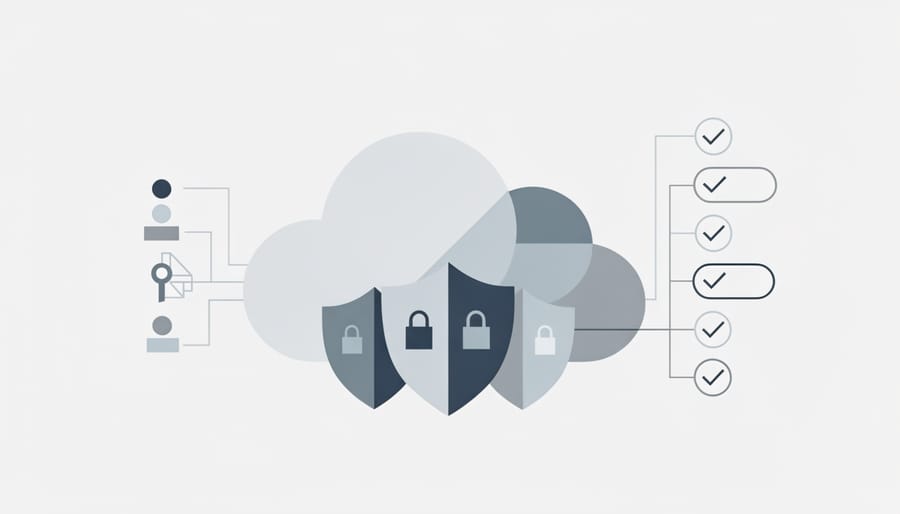
A comprehensive cloud infrastructure strategy rests on six interconnating elements that work together to deliver both agility and control. Canadian enterprises that address each component systematically build resilient, scalable environments aligned with their business objectives.
- Workload distribution: Strategic placement of applications and services across on-premises, public cloud, and private cloud environments based on performance requirements, data sensitivity, and cost considerations.
- Data management: Policies governing data storage locations, backup procedures, retention schedules, and cross-border data flows, particularly critical for organizations handling personal information under provincial privacy laws.
- Security architecture: Layered protection encompassing identity and access management, network segmentation, encryption standards, and threat detection aligned with recognized cybersecurity frameworks.
- Cost optimization: Mechanisms for tracking spending, rightsizing resources, leveraging reserved instances or savings plans, and eliminating waste through automated monitoring and governance.
- Compliance: Controls ensuring adherence to industry regulations, data sovereignty requirements, and internal policies, from financial services rules to healthcare privacy standards.
- Performance monitoring: Continuous measurement of application response times, resource utilization, availability metrics, and user experience to inform refinement decisions.
The workload distribution component requires honest assessment of which applications belong where. Not every system benefits from cloud migration. Legacy applications with stable workloads and minimal integration needs often run more economically on existing infrastructure, while variable-demand services gain from cloud elasticity.
Data management goes beyond simply choosing storage locations. Effective strategies define clear pathways for data lifecycle management, establish backup and disaster recovery protocols that meet specific recovery time objectives, and address data residency requirements for organizations serving multiple provinces or international markets.
Security architecture demands particular attention in hybrid and multi-cloud environments where attack surfaces expand. The strongest strategies embed security throughout the infrastructure rather than treating it as a perimeter concern, incorporating zero-trust principles and continuous verification regardless of where users or resources reside.
Cost optimization separates successful cloud strategies from expensive experiments. This component includes tagging resources for departmental chargeback, setting budget alerts, regularly reviewing underutilized assets, and matching service tiers to actual performance needs rather than defaulting to premium options.
Performance monitoring closes the loop, providing the metrics needed to validate that the strategy delivers intended outcomes. These measurements inform capacity planning, reveal optimization opportunities, and demonstrate return on investment to stakeholders who control budgets.
Cloud Deployment Models and When to Use Them
Canadian enterprises have four primary cloud deployment models to consider, each offering distinct characteristics that align with different business needs, compliance requirements, and operational priorities.
Public cloud delivers infrastructure services through third-party providers like Amazon Web Services, Microsoft Azure, or Google Cloud Platform. These platforms offer virtually unlimited scalability, predictable operational costs, and no capital expenditure for hardware. Canadian businesses favour public cloud for non-sensitive workloads, development environments, and applications requiring rapid scaling. Retail companies use it for e-commerce platforms that experience seasonal traffic spikes, while startups leverage it to minimize upfront infrastructure investment during growth phases.
Private cloud provides dedicated infrastructure operated solely for one organization, either on-premises or hosted by a specialized provider. This model delivers maximum control over security, customization, and compliance, crucial factors for financial institutions, healthcare providers, and government entities handling sensitive Canadian data. Banks typically run core banking systems on private cloud to maintain strict security protocols and meet regulatory requirements. The trade-off comes in higher costs and internal management responsibility, but many organizations consider this worthwhile for mission-critical systems.
Hybrid cloud combines public and private environments, allowing data and applications to move between them as needs change. This model has become the preference for many Canadian enterprises pursuing digital adoption while maintaining legacy systems. Manufacturing firms might keep proprietary design data on private infrastructure while running analytics workloads in public cloud. Insurance companies often process claims on public platforms but store policyholder records privately. Hybrid approaches provide flexibility without forcing immediate wholesale migration.
Multi-cloud strategy uses services from multiple cloud providers simultaneously, avoiding vendor lock-in and optimizing for specific capabilities. An enterprise might use Azure for Microsoft-integrated applications, AWS for machine learning tools, and a Canadian provider for data sovereignty requirements. This approach offers resilience, if one provider experiences outages, critical operations continue, but introduces management complexity. Larger Canadian organizations with sophisticated IT teams increasingly adopt multi-cloud to match workloads with the best-performing, most cost-effective platform for each specific need.
How Canadian Enterprises Apply Cloud Infrastructure Strategy

Canadian enterprises deploy cloud infrastructure strategy across five core scenarios, each addressing distinct operational challenges while supporting broader business objectives.
Digital transformation initiatives lead adoption patterns. Retailers modernize point-of-sale systems and inventory management through cloud platforms, enabling real-time data synchronization across locations. Manufacturing firms integrate IoT sensors with cloud analytics to optimize production lines and predict equipment maintenance needs. Financial services providers migrate legacy systems to cloud architectures, accelerating product launches from months to weeks while reducing infrastructure costs by 30-40%.
Scalability for growth drives cloud adoption among expanding businesses. E-commerce companies leverage auto-scaling capabilities to handle seasonal demand spikes, Black Friday traffic surges, without over-provisioning resources year-round. SaaS providers serving North American markets deploy multi-region architectures to reduce latency and support customer growth. A Vancouver-based software company scaled from 200 to 2,000 enterprise clients in eighteen months using elastic cloud infrastructure, avoiding the capital expenditure and lead times traditional data centers would require.
Disaster recovery and business continuity planning has become foundational. Organizations implement geographically distributed backup systems, ensuring data replication across Canadian regions. When ransomware attacks occur, cloud-based recovery systems restore operations within hours rather than days. Insurance firms maintain regulatory compliance while achieving recovery time objectives under four hours through automated failover mechanisms.
Remote workforce enablement accelerated during 2020 and remains permanent for many enterprises. Cloud-based collaboration platforms, virtual desktop infrastructure, and secure access protocols support distributed teams. Professional services firms provide seamless client service regardless of employee location. Integrating 5G cloud capabilities enhances mobile workforce productivity through faster data access and real-time application performance.
Regulatory compliance shapes strategy particularly for organizations handling sensitive data. Healthcare providers deploy private cloud environments meeting provincial health information privacy requirements while maintaining interoperability. Financial institutions architect hybrid solutions keeping customer data within Canadian borders while leveraging public cloud for analytics workloads, satisfying both PIPEDA obligations and operational efficiency goals.
Common Questions About Cloud Infrastructure Strategy
Cloud infrastructure strategy raises practical questions for Canadian business leaders evaluating this investment. The answers depend on your organization’s size, current infrastructure state, and strategic objectives, but common patterns emerge across enterprises.
How much does a cloud infrastructure strategy cost?
Costs vary widely based on workload complexity, data volumes, and chosen deployment models, but Canadian enterprises typically spend between $50,000 and $500,000 annually on cloud infrastructure, with strategic planning and migration projects adding $25,000 to $200,000 in initial investment. Small and medium enterprises often start with $10,000 to $50,000 for foundational strategy development and pilot implementations.
How long does implementation take?
A comprehensive cloud infrastructure strategy typically takes three to six months to develop and twelve to eighteen months for full implementation across an enterprise. Phased approaches allow businesses to realize benefits incrementally, with initial workloads often migrating within the first quarter after strategy approval.
What about Canadian data sovereignty requirements?
Canadian enterprises must ensure their cloud strategy addresses federal and provincial data residency laws, particularly for sectors like healthcare, finance, and government services. Major cloud providers now offer Canadian data centre regions, allowing organizations to keep sensitive data within national borders while maintaining compliance with privacy legislation.
Can small and medium enterprises benefit from cloud infrastructure strategy?
Absolutely. SMEs often gain the most significant competitive advantages because cloud infrastructure eliminates the need for large capital investments in physical data centres and provides enterprise-grade capabilities at operational expense pricing. Strategic planning helps smaller organizations avoid costly missteps and scale efficiently as they grow.
How do you measure ROI on cloud infrastructure?
Track both hard and soft metrics: infrastructure cost reductions, deployment speed improvements, system uptime percentages, and eliminated capital expenditures for tangible returns. Also measure business enablement factors like faster time-to-market for new products, improved customer experience scores, and increased workforce productivity from anywhere-access capabilities.
Does cloud strategy require replacing all existing systems?
No. Most successful strategies embrace hybrid approaches that integrate cloud services with existing on-premises infrastructure where it makes sense, migrating workloads selectively based on business value and technical feasibility rather than pursuing wholesale replacement.
The strategic value extends beyond immediate cost considerations. Canadian enterprises that invest in thoughtful cloud infrastructure planning position themselves to adapt quickly to market changes, support distributed workforces effectively, and compete with larger organizations on technology capabilities. The question isn’t whether cloud strategy justifies its cost, but rather what opportunities your business misses without it.
A well-crafted cloud infrastructure strategy isn’t just an IT priority, it’s a business imperative that determines how effectively Canadian enterprises can compete, scale, and innovate. The organizations that thrive in 2026 are those that approach cloud infrastructure deliberately, aligning technology decisions with business outcomes rather than adopting solutions reactively.
Canada’s regulatory environment, technological infrastructure, and skilled workforce create ideal conditions for sophisticated cloud strategies. Whether you’re operating a mid-sized manufacturer in Ontario or a tech startup in Vancouver, the strategic framework remains consistent: assess your current state honestly, define clear objectives, choose the right deployment models, and commit to continuous optimization.
Now is the time to evaluate your organization’s cloud approach. Does your current infrastructure support your growth trajectory? Are you optimizing costs while maintaining security and compliance? Have you addressed data sovereignty requirements specific to Canadian operations?
The complexity of cloud infrastructure strategy makes expert guidance valuable. Connecting with experienced cloud architects, attending industry events, and engaging with professional networks can accelerate your strategic development. Canada’s innovation ecosystem offers abundant resources, leverage them to build infrastructure that drives sustainable competitive advantage.