

A successful virtual onboarding journey transforms new hires into productive, engaged team members within 30 to 90 days through a structured program that combines technology, human connection, and clear milestones. Canadian organizations that implement purposeful remote onboarding see 25% higher retention rates and 30% faster time-to-productivity compared to those that simply digitize paper-based processes.
The shift to remote and hybrid work has made onboarding more complex, but also more trackable and consistent. Where office-based onboarding once relied on informal hallway conversations and desk drop-bys, virtual programs now require deliberate touchpoints, documented workflows, and intentional relationship-building. Toronto-based Shopify refined its remote onboarding after 2020, creating a phased approach that pairs asynchronous learning modules with scheduled video check-ins, resulting in new hires who report feeling connected to company culture despite never setting foot in an office.
Building an effective virtual onboarding journey demands more than shipping a laptop and scheduling a few Zoom calls. You need a clear timeline that spans pre-boarding through the first 90 days, role-specific training paths, compliance documentation that meets provincial employment standards, and meaningful ways for new employees to build relationships with colleagues. The framework mirrors principles found in any strong hybrid-remote playbook: structure enables flexibility, and technology supports human connection rather than replacing it.
This guide walks you through each phase of designing and executing a virtual onboarding program that works for Canadian businesses, from the tools you’ll need to the metrics that prove it’s working.
What You Need Before Starting Your Virtual Onboarding Program
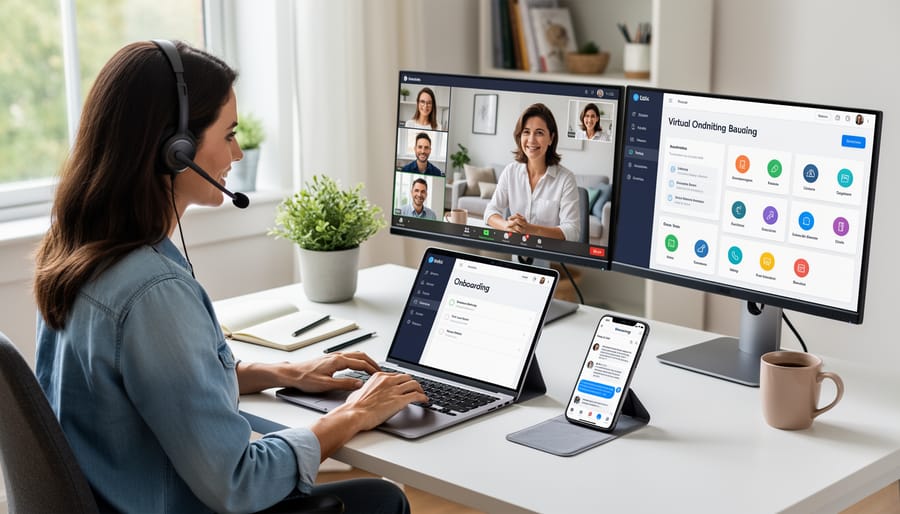
Before launching your virtual onboarding program, you need the right infrastructure and resources in place to ensure new remote employees feel supported from day one. The success of your onboarding journey depends on preparation, assembling the right technology stack, creating comprehensive content assets, and ensuring your internal team is ready to guide new hires through their first 90 days.
Your digital infrastructure forms the backbone of virtual onboarding. Invest in reliable video conferencing platforms like Zoom or Microsoft Teams that support group calls, screen sharing, and recording capabilities for training sessions. A Learning Management System (LMS) such as TalentLMS or Absorb LMS centralizes training modules and tracks completion rates. Your Human Resources Information System (HRIS), whether it’s BambooHR, ADP Workforce Now, or a similar platform, should handle documentation, compliance tracking, and workflow automation. These digital HR tools must integrate smoothly to create a seamless experience rather than forcing new employees to navigate disconnected systems.
Here’s what you need assembled before your first virtual new hire arrives:
- Technology stack: Video conferencing accounts, LMS access, HRIS credentials, collaboration tools (Slack, Microsoft Teams), project management software
- Content library: Employee handbook (digital format), role-specific training videos, company culture overview presentation, department org charts, process documentation
- Equipment and logistics: Laptop, monitor, headset, company swag package with shipping plan, IT setup instructions, VPN access credentials
- Team preparation: Assigned mentor or buddy identified and briefed, manager trained on onboarding expectations, IT support contact designated, HR onboarding specialist assigned
- Documentation: Clear job description, first 30/60/90-day goals document, team contact list with roles, learning path roadmap, compliance checklist for provincial requirements
Content quality matters as much as quantity. Your welcome video should feature the CEO or department head speaking directly to new hires, not a scripted corporate message. Training modules need real scenarios and examples from your actual work environment, not generic content purchased off the shelf. Each piece should answer the questions new remote employees ask most: Who do I contact when I need help? What does success look like in my first month? How does my work connect to company goals?
Critical Pitfalls and Compliance Considerations

Even well-intentioned virtual onboarding programs can fail if they ignore common pitfalls or overlook Canadian regulatory requirements. The most frequent mistake is information overload. Bombarding new hires with dozens of training modules, policy documents, and system walkthroughs in the first week creates cognitive fatigue and reduces retention of critical information. Break content into digestible chunks spread across the first 30 days, prioritizing what employees need immediately versus what can wait.
Cultural disconnection poses another serious risk in virtual settings. Without spontaneous hallway conversations or coffee breaks, remote employees can feel isolated from company values and team dynamics. Schedule deliberate touchpoints with peers and leaders, use video for meaningful interactions, and create informal virtual spaces where employees can connect beyond work tasks.
On the compliance front, Canadian employers must navigate several regulatory frameworks when onboarding remote workers. The PIPEDA rules for personal info require clear consent and secure handling of employee data collected through onboarding systems and monitoring tools. Store personal information on Canadian servers when possible and document your data protection measures.
Workplace safety obligations extend to home offices. Health and safety when working from home remains an employer responsibility, requiring ergonomic guidance, equipment standards, and clear reporting procedures for work-related injuries. Incorporate home workspace assessments into your onboarding checklist.
Accessibility standards matter from day one. Ontario’s AODA and federal accessibility legislation mandate barrier-free onboarding materials. Provide captioned videos, screen-reader-compatible documents, and alternative formats for all training content. Test your platforms with assistive technologies before launch to ensure every new hire can participate fully regardless of ability.
Step-by-Step Process to Design Your Virtual Onboarding Journey
Pre-Arrival: Setting the Stage (Week Before Start Date)
The week before a new remote employee’s start date determines whether they arrive excited and prepared or anxious and disconnected. Begin by shipping a welcome package containing company-branded items, a handwritten note from their manager, and a clear first-day agenda. This physical touchpoint creates emotional connection before the digital relationship begins.
Coordinate with IT to configure hardware, software licenses, and system access. Ship laptops and equipment three to five days early so employees can test connectivity and troubleshoot issues before day one. Create login credentials for email, project management tools, communication platforms, and any role-specific systems. Send a simple setup guide with screenshots and a direct contact for technical questions.
Assign a peer buddy, ideally someone in a similar role who joined within the past year. Have the buddy send a casual welcome message introducing themselves and offering to answer questions. This reduces the intimidation of reaching out to strangers.
Schedule the first week’s meetings in advance: day-one orientation, team introductions, one-on-ones with key stakeholders, and training sessions. Send calendar invites with video links and brief agendas. Confirm your new hire’s home office setup is ergonomically sound and compliant with provincial workplace safety standards.
This preparation signals professionalism and reduces first-day friction, allowing employees to focus on learning rather than logistics.
Day One: The Virtual Welcome Experience

The first day sets the tone for the entire employee experience. Start at 9:00 AM with a personalized welcome email from the CEO or department head, a short video works best, addressing the new hire by name and expressing genuine excitement about their arrival. This human touch matters more in remote settings where physical presence can’t convey warmth.
By 10:00 AM, schedule a team video call. Keep it informal: have each person share their role, a fun fact, and how they’ll interact with the newcomer. Avoid back-to-back meetings; build in 15-minute breaks so the employee can process information without Zoom fatigue.
The afternoon focuses on system access. Assign an IT buddy to walk through email, collaboration tools, file storage, and communication platforms via screen share. This isn’t a lecture, make it interactive. Have the new hire actually send a test message, create a document, and find key resources while guided.
Around 2:00 PM, introduce the first training module through your digital onboarding platform. Keep it under 30 minutes, company mission, values, and basic policies. End the day by 4:00 PM with a check-in from their direct manager. Ask: “What went well? What felt overwhelming?” Listen carefully. That feedback shapes day two and reveals whether your structure actually works.
Week One: Foundational Training and Integration
The first week transforms orientation momentum into sustained engagement through structured daily objectives that blend learning with connection.
Day Two: Culture Deep-Dive
Schedule a 90-minute culture session covering company values, communication norms, and decision-making processes. Pair this with informal virtual coffee chats where new hires meet cross-functional colleagues. Assign one achievable task they can complete independently to build confidence.
Days Three-Four: Role Foundations
Deliver core job training through a mix of recorded modules and live sessions with subject matter experts. Break content into 45-minute blocks with active participation. Have the new employee shadow team members during client calls or project work. End Day Four with a small win: completing a real deliverable, even if it’s reviewing a document or contributing to a team discussion.
Day Five: Department Connections
Organize brief introductions with key stakeholders across departments they’ll collaborate with regularly. Conduct the first informal check-in to gauge comfort levels, answer questions, and adjust the Week Two plan based on their pace.
Balance remains critical: dedicate mornings to structured learning, afternoons to relationship-building and applied work. Avoid back-to-back video calls; schedule breaks for asynchronous learning and reflection.
Month One: Role Mastery and Feedback Loops

The first 30 days represent a critical transition from foundational learning to genuine contribution. By this point, your new remote employee should shift from absorbing information to applying skills independently while receiving structured support.
Schedule biweekly one-on-ones with the direct manager during this period. These conversations should go beyond task updates to explore challenges, gather feedback on the onboarding experience, and adjust workload as needed. Create a safe space for honest dialogue about what’s working and what isn’t.
Implement peer shadowing sessions where the new hire observes colleagues handling real work scenarios, client calls, problem-solving sessions, or cross-functional collaboration. Record these sessions when possible so remote employees can review them later. This exposure to different working styles accelerates learning and builds internal networks.
Assign progressively complex projects that require collaboration with multiple team members. These assignments test both technical competence and cultural integration while revealing any skill gaps early.
Conduct a formal 30-day performance conversation focusing on strengths demonstrated, areas for development, and goals for the next 60 days. Use engagement survey data, completed training metrics, and manager observations to identify warning signs like declining participation in team meetings or missed deadlines.
Address concerns immediately through targeted coaching or additional resources rather than waiting for the 90-day review.
Days 31-90: Full Integration and Independence
By day 31, your new employee should transition from structured training to meaningful contribution. This phase marks their evolution into a self-sufficient team member who understands not just their role, but how it advances broader business objectives.
The 31-90 day period demands a strategic shift in your approach:
- Days 31-45: Assign the first independent project with clear deliverables but minimal oversight. Schedule weekly rather than daily check-ins to encourage problem-solving autonomy.
- Days 46-60: Involve them in cross-functional initiatives where they contribute ideas during planning meetings. This builds understanding of how departments interconnect across your Canadian operations.
- Days 61-75: Introduce strategic responsibilities aligned with their role’s core purpose. For sales positions, this means owning client relationships; for developers, leading feature development; for operations staff, process optimization.
- Days 76-85: Conduct informal culture assessments through casual conversations about team dynamics, communication preferences, and workplace values. Address any disconnection before it calcifies.
- Days 86-90: Complete the formal 90-day performance review with specific examples of contributions, areas for development, and clear expectations for the next quarter.
Throughout this period, reduce scheduled touchpoints but maintain open communication channels. Encourage them to participate in employee resource groups, optional social events, and knowledge-sharing sessions. By day 90, they should feel genuinely integrated into your organization’s culture, not just competent in their tasks.
The successful completion of this phase signals readiness for standard performance management cycles and full team membership.
How to Measure Success and Verify Your Onboarding Effectiveness
Measuring your virtual onboarding effectiveness requires tracking specific indicators that reveal whether new hires are truly integrating and contributing. Start with time-to-productivity metrics, quantify how long it takes new employees to complete their first meaningful project, handle independent work assignments, or reach defined performance benchmarks. Canadian enterprises typically see fully remote hires reach productivity between 45-60 days when onboarding is structured effectively.
Track retention at critical milestones: 30-day, 60-day, and 90-day retention rates tell you if employees are staying engaged beyond the honeymoon period. If you’re losing people before day 90, your onboarding process likely has gaps in connection, clarity, or support. Industry benchmarks suggest 90-day retention above 85% indicates a healthy program, while anything below 75% demands immediate investigation.
Employee satisfaction data provides qualitative depth that numbers alone miss. Deploy short pulse surveys at days 7, 30, and 90 asking targeted questions: Did you have the tools needed on day one? Do you understand your role clearly? Do you feel connected to your team? Combine these with structured one-on-one conversations where managers probe beyond surface-level responses to uncover genuine concerns about workload, communication, or cultural fit.
Manager feedback completes the picture. Your hiring managers see daily work quality, responsiveness, and integration speed firsthand. Create a simple feedback mechanism where managers rate new hire progress against role-specific competencies at each milestone, identifying strengths and development areas.
Gather these data-driven metrics through your HRIS platform, engagement tools like Officevibe or CultureAmp, and calendar analytics that show meeting participation patterns. Review the aggregate data quarterly, identifying trends across departments, roles, or remote versus hybrid positions. Use these insights to refine your onboarding timeline, adjust training content, strengthen buddy assignments, or increase manager touchpoints. Effective measurement isn’t about collecting data, it’s about acting on what you learn to make each cohort’s experience stronger than the last.
Canadian Success Stories: Virtual Onboarding in Action
When Shopify transitioned to “digital by default” in 2020, the Ottawa-based tech giant built a virtual onboarding framework that now serves as a blueprint for Canadian companies. Their program reduced time-to-first-contribution from 45 days to 28 days while maintaining 94% new hire retention after six months. “We replaced office tours with virtual culture sessions and paired every new developer with a peer mentor for daily video check-ins during week one,” explains Sarah Chen, Shopify’s VP of People Operations. “The structured touchpoints created connection without overwhelming people.”
TD Bank took a different approach when onboarding 1,200 financial advisors remotely across Canada in 2025. They developed role-specific learning paths within their LMS, incorporated compliance training through interactive scenarios, and scheduled weekly virtual coffee chats with senior leaders. The result: 89% of new advisors hit their first-quarter targets compared to 76% under the previous in-office model. Their success demonstrates how retention strategies must adapt to remote realities.
Manufacturing presents unique challenges, yet Linamar Corporation in Guelph successfully onboarded 200 engineers virtually by combining digital training modules with supervised equipment familiarization at regional facilities. They assigned experienced engineers as virtual guides who walked new hires through technical processes via augmented reality tools before any hands-on work. This hybrid approach cut onboarding costs by 40% while maintaining safety standards and technical competency.
These examples share common threads: dedicated mentorship, phased information delivery, frequent manager touchpoints, and measurable milestones that verify progress rather than just tracking completed modules.
Common Questions About Virtual Onboarding Journeys
Virtual onboarding raises distinct challenges that differ significantly from traditional in-person processes. Canadian organizations implementing remote hiring programs consistently encounter similar questions as they refine their approaches. Here are practical answers to the most common concerns.
How do we onboard employees across multiple time zones in Canada?
Schedule core onboarding sessions during overlapping business hours (typically 10 AM to 2 PM Eastern when accommodating Pacific time zones), record all training sessions for asynchronous viewing, and assign mentors in similar time zones when possible. Consider staggered start times that align with the employee’s local working hours rather than forcing coast-to-coast alignment from day one.
What’s the best approach for shipping equipment to remote employees?
Send equipment 5-7 business days before the start date with tracking, include setup instructions and IT contact information in the package, and schedule a tech check call for the day before or morning of day one. For employees in remote locations, partner with local IT support providers or ship backup equipment to avoid connectivity delays.
How do we maintain company culture when everyone is remote?
Integrate culture through storytelling in welcome videos, schedule informal virtual coffee chats with team members beyond direct colleagues, create Slack channels or Teams groups for non-work interests, and incorporate your values into onboarding checkpoints rather than treating culture as a separate module. Make founders or executives personally available during the first week to share the company’s mission and answer questions directly.
Should executive onboarding differ from entry-level processes?
Yes, significantly. Executives need strategic context, stakeholder mapping, early access to leadership forums, and accelerated decision-making authority, often compressed into 30 days rather than 90. Entry-level employees benefit from structured daily activities, frequent check-ins, granular training modules, and longer ramp-up periods with more hands-on guidance from mentors.
Do contract workers require the same onboarding as full-time employees?
Contract workers need streamlined onboarding focused on immediate project requirements, essential compliance training, system access, and key contacts, typically completed in 1-3 days rather than weeks. Skip long-term culture integration and career development content, but don’t eliminate the welcome completely, contractors who feel connected deliver better work and often convert to permanent roles.
These questions reflect the evolving reality of Canadian workplaces where remote and hybrid models are now standard rather than exceptional. The organizations that address these logistics proactively see higher engagement scores and faster productivity ramps. Remember that your onboarding approach will continue to evolve as you gather feedback from each cohort of new hires, so treat these solutions as starting points rather than fixed protocols.
Next Steps: Implementing Your Virtual Onboarding Strategy
Your virtual onboarding program is more than an HR process, it’s a strategic investment that directly impacts retention, productivity, and your company’s reputation in competitive talent markets. The difference between a new hire who thrives and one who quietly disengages often comes down to those critical first 90 days.
Start by auditing your current approach against the framework outlined in this guide. Identify gaps in your technology infrastructure, content assets, and compliance documentation. Assign clear ownership for each phase of the onboarding journey, from pre-arrival through the three-month mark. Set measurable objectives tied to retention rates, time-to-productivity, and engagement scores so you can demonstrate ROI to leadership.
Canadian businesses can access valuable support through federal and provincial programs. The Canada Digital Adoption Program offers funding for technology upgrades that enhance remote work capabilities. Provincial business advisory services provide guidance on employment standards and accessibility compliance specific to your region. Many industry associations also share virtual onboarding templates and peer learning opportunities.
Don’t attempt to perfect every detail before launching. Implement a pilot program with your next cohort of hires, gather feedback rigorously, and refine your approach based on real data. The competitive advantage goes to organizations that act decisively and improve continuously.
Strong virtual onboarding transforms geographical distance from a barrier into an opportunity, allowing you to attract top talent regardless of location while building a cohesive, engaged workforce. Take the first step this week, your future employees and your bottom line will both benefit.